
Another reconstruction won't close your finding
Rebuilding the evidence answers today's supervisor question. It does nothing for the next one.
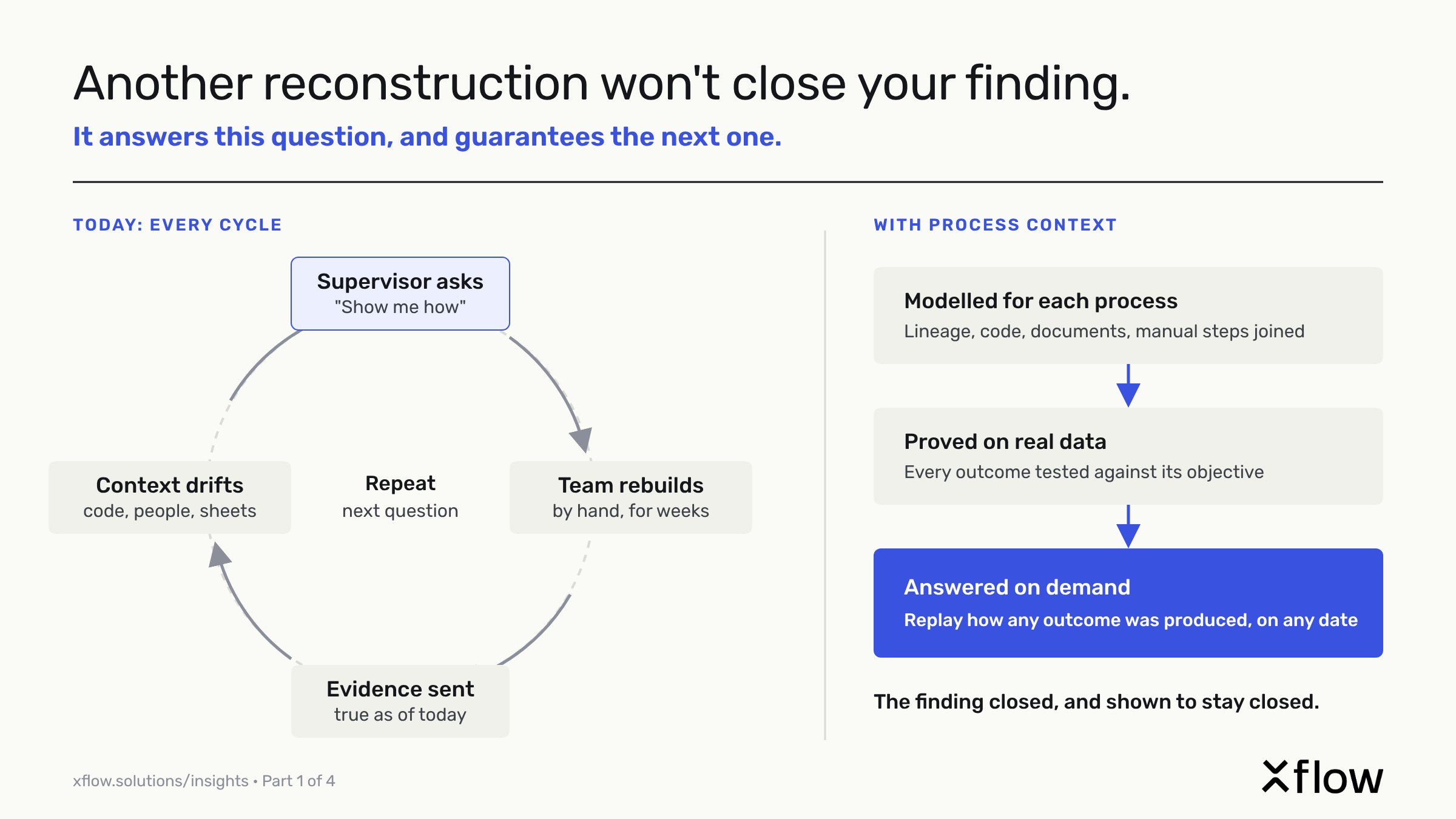
A supervisor asks how a reported outcome was produced. A team that should be closing the quarter spends the next three weeks reassembling the answer: who ran which step, which rule the code applied, which spreadsheet made the last adjustment. The answer goes back to the supervisor. It is accurate on the day it is sent.
This is for the person who owns that week. If there is an open finding on risk data aggregation, a remediation plan with a date on it, or a supervisor who has started asking "show me" rather than "tell me", read on. If not, this is probably not your problem yet.
The question has changed
For a decade, BCBS 239 assessments asked whether the principles were in place: governance, data architecture, accuracy, completeness, timeliness, adaptability. The ECB's Guide on effective risk data aggregation and risk reporting, published in May 2024, moved the emphasis. Supervisors now expect evidence that the data behind a report is accurate and complete, that the controls work, and that remediation has happened, not that it has been planned.
That turns a documentation question into a proof question. And proof has to be produced for a specific outcome, on a specific date, through a specific route.
The options on the table
Nobody in this position does nothing. These are the options usually weighed, and each one is reasonable.
Rebuild the evidence by hand. Bring the people who know the process into a room, trace the outcome from the return back to source, document the steps and attach the reconciliations. It works, and it is how most findings are answered today. Where it stops: the evidence is true as of the day it was assembled. The next code release, the next manual adjustment or the next person to leave puts it out of date, and the next question starts the rebuild again.
Extend the lineage tool. Push the catalogue further, add scanners, close the coverage gaps. Where it stops: lineage shows how data moves between systems. It usually stops at the application code where the rule actually runs, and it does not see the adjustment made in a spreadsheet the night before submission. Part 3 goes into this in detail.
Bring in an adviser. Experienced people, a structured method and a credible report for the supervisor. Where it stops: the result is a better reconstruction, delivered once. When the team leaves, the knowledge leaves with it.
Wait for the data platform programme. The new platform will fix lineage by design. Where it stops: the finding has a date, and the programme does not.
All four produce a description of how the outcome was produced. None produces something that stays true when the process changes.
What proving it actually requires
To answer the supervisor on demand rather than in weeks, four things have to be true at the same time.
- The context is connected. The business term, the data model, the code that implements the rule, the manual adjustment and the policy all refer to the same thing, and it is possible to move between them.
- It is tested. The rule as documented has been run against real data, and the outcome checked against what the process is meant to achieve.
- It is current. When the code changes, it is clear which outcomes moved.
- It can be replayed. The route any outcome took, on any date, can be shown without assembling a team.
Every piece of this already exists in the institution: lineage in the catalogue, requirements in documents, rules in code, adjustments in spreadsheets, definitions in data governance. What is missing is the thing that joins them up and keeps them joined.
Process context
That is what xflow builds. It takes the data governance, lineage, code, documents and manual steps an institution already has and models them as process context: one connected view per process, tested on real data, with every outcome validated against its objective.
Nothing is replaced. The catalogue stays the catalogue. What changes is the answer that can be given. Every return is signed with certainty, because every outcome is proved before it reaches the regulator. The supervisor is answered on demand, not after weeks of rebuilding. And a finding can be closed, because the fix can be shown to have been made and to be still working.
At a global tier one bank, lineage for regulatory reporting stopped where the application code began. xflow connected to the code repositories and produced the first analysis in hours. Transformation gaps were closed and written back to the bank's data governance layer, giving end-to-end lineage from policy to process to code to data.
Five questions about your own process
Pick the one return or risk report you would least like a supervisor to ask about.
- Could you show how last quarter's headline outcome was produced without convening a meeting?
- Does your lineage reach the code that applies the rule, or stop at the system boundary?
- Are the manual adjustments in that process mapped anywhere other than the spreadsheet itself?
- If a developer changed that code tomorrow, would anyone in reporting know which outcomes moved?
- For your last closed finding, could you evidence today that the fix is still in place?
Three or more answers of "no" mean the project already exists. The only question is whether the next answer is another reconstruction.
Next in the series: the same problem from the other side of the bank. Your agent works. Risk still won't sign it off.