
Your agent works. Risk still won't sign it off.
The go-live gate is not a model problem. It is a proof problem.
The pilot worked. The demo landed. The business sponsor wants it live. And for weeks the agent has sat with risk and compliance, through a model risk review, a second round of questions and a request for evidence nobody quite knows how to produce. Getting an agent from pilot to production in a bank has become a question of AI agent governance, not technology.
This is for the person who owns that agent. If there is an agent in a credit, claims, onboarding, reporting or controls process that is ready technically and blocked procedurally, read on. If your agents are still experiments, keep it for later.
Part 1 argued that rebuilding evidence by hand answers one supervisor question and guarantees the next. Agents have the same problem, with less patience.
What risk is actually asking
It is tempting to read a blocked go-live as caution about the model. Usually it is not. The questions coming back from a model risk review tend to collapse into four.
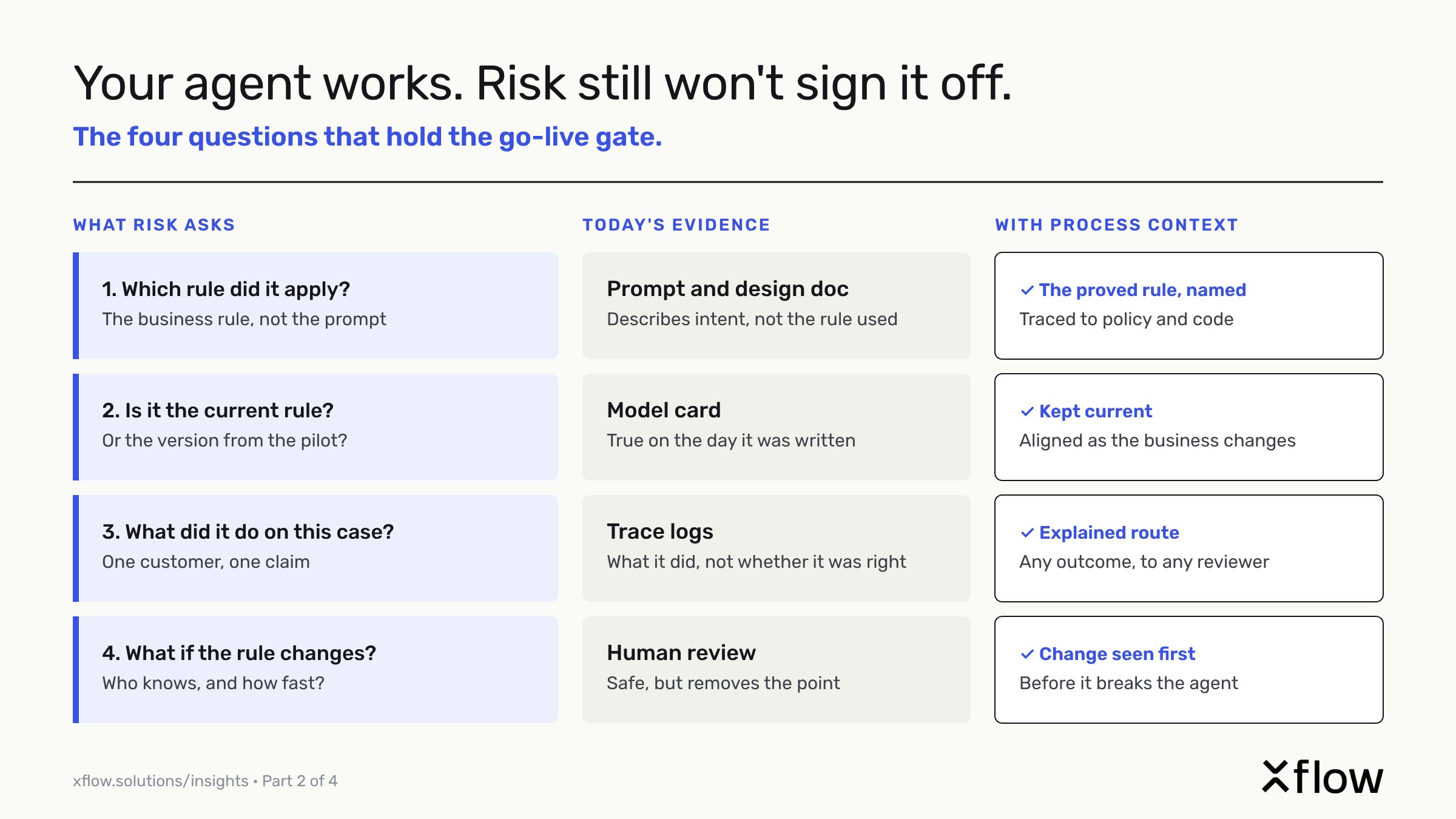
- Which rule did it apply? Not the prompt: the business rule. The eligibility criterion, the materiality threshold, the reserving assumption.
- Is that the current rule? The one in the policy approved last month, or the one in the document the agent was given in the pilot?
- What did it do on this case? The route from input to outcome for one customer, one claim, one exposure.
- What happens when the rule changes? Who knows, and how quickly, that the agent is applying an out-of-date version?
These questions are not new. The PRA's SS1/23 expects banks to identify, validate and monitor the models used to inform business decisions, a definition that can reach an agent making or supporting a decision. Under the EU AI Act, creditworthiness assessment and life and health insurance pricing are high-risk uses, with record-keeping, transparency and human oversight duties that apply from December 2027. A risk function asking these questions is doing its job.
The options on the table
A better model. Newer, larger, better at reasoning. Where it stops: a better model applies the wrong rule more fluently. Risk's questions are about the rule, not the reasoning.
More documentation. Model cards, prompt libraries, a test pack, a design document. Where it stops: documentation describes the agent on the day it was written. It does not show which rule was applied on a given case, and it goes stale the first time a policy changes.
Tighter guardrails and human review. A person in the loop for every outcome. Where it stops: sign-off is won by removing most of the reason to have the agent, and it does not scale beyond the first team.
Logging and tracing. Record every call. Where it stops: a trace shows what the agent did. It does not show whether what it did was right, because the rule it should have applied lives somewhere else.
Each answers part of one question. None answers all four.
The missing piece is context that can be proved
An agent in a regulatory process is only as trustworthy as the context it acts on: the rules, definitions, data and process steps that say what right means. In most institutions that context is scattered across documents, code, data governance tools and the knowledge of people who may have moved on. The agent gets a copy. Risk cannot see which copy, or whether it is still true.
xflow builds that context as process context: modelled for each process from what the institution already has, tested on real data and kept current as the business changes. The rules an agent must apply are held once as governed definitions, and the agent points at them rather than carrying its own copy. The rule applied at runtime is the rule that was designed, validated and evidenced, and risk can see it.
What changes is what can be shown. Risk sees the proved rules the agent applies, and signs it off. The agent stays in production, because it keeps working when a rule changes. Any outcome, on any case, can be explained to any reviewer. And the next use case does not start from scratch, because the context is already built.
Five questions about your own agent
Take the agent closest to go-live.
- Can you name the specific business rules it applies, and where the approved version lives?
- Has each of those rules been tested against real data, separately from testing the agent?
- For one case it handled last week, could you show the rule it used and why?
- If the policy behind one of those rules changed tomorrow, how would the agent find out?
- Could a second team reuse the same context, or would they start again?
Three or more answers of "no", and the go-live gate will not move for a better model.
Next in the series: back to the reported outcome, and the exact point where lineage stops seeing how it was produced. Where lineage stops, the questions start.