
Where lineage stops, the questions start
The catalogue sees the data. The outcome is produced somewhere it cannot see.
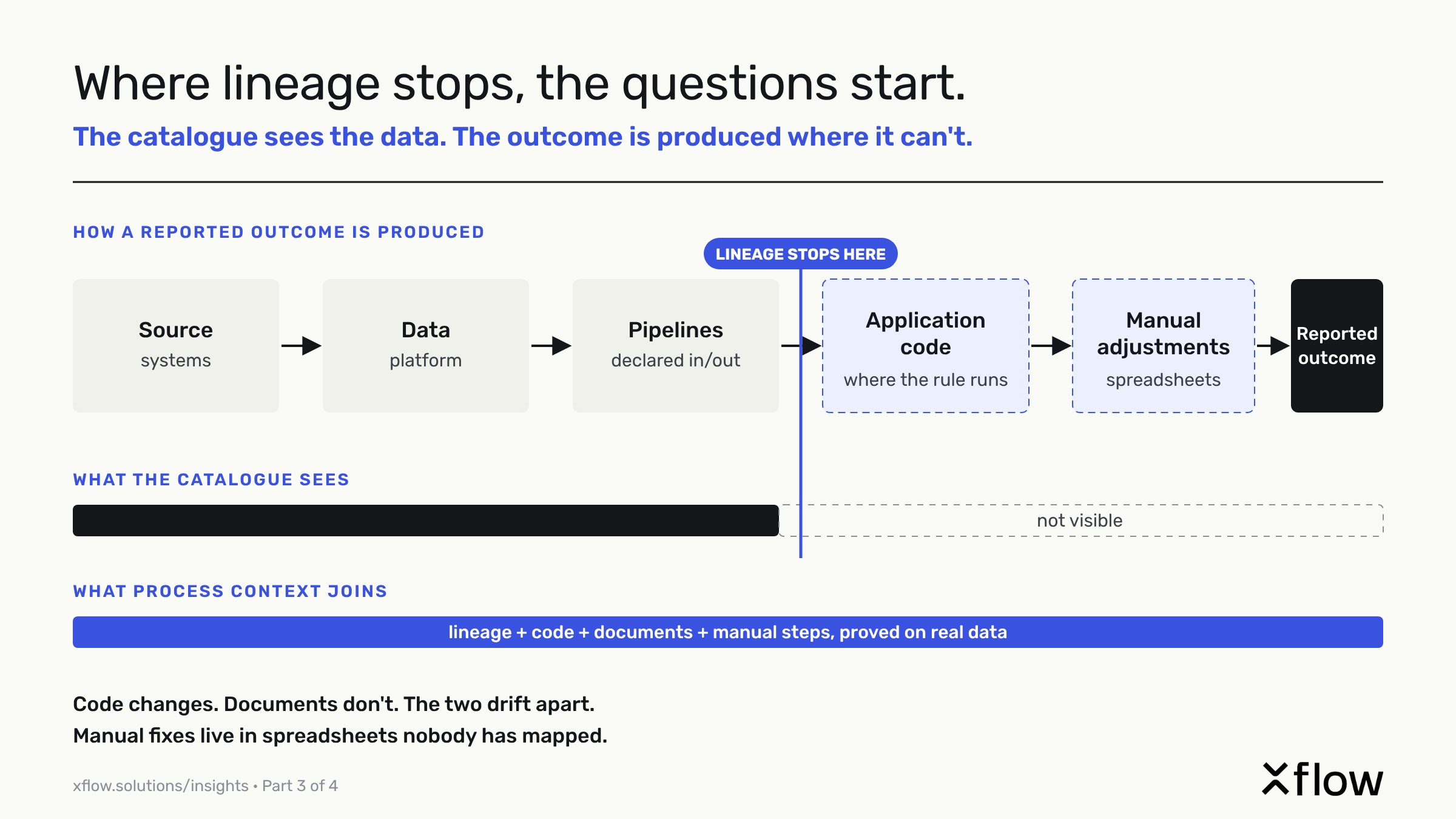
"Lineage stops at the application code." The sentence comes up in almost every conversation with regulatory reporting teams, usually after the second follow-up question from a supervisor. The lineage diagram was impressive. It just ended one step before the place where the outcome was actually produced.
Part 1 argued that another reconstruction won't close a finding. This part is about why the reconstruction keeps being needed: the gap the tools cannot see.
Three places an outcome is produced
Follow a reported figure back to source, whether it is a FINREP template, a COREP capital line, a Solvency II quantitative reporting template or an IFRS 17 disclosure. It passes through three kinds of place.
Places the catalogue sees. Source systems, the data platform, transformation pipelines with declared inputs and outputs. Lineage tools are good here, and they have improved a great deal.
Code the catalogue does not read. The calculation engine, the allocation logic, the stored procedure written ten years ago, the rule buried in an application whose source nobody owns. This is where the business rule actually runs. Lineage sees data go in and data come out. It does not see which rule turned one into the other, or whether that rule matches the one in the requirements document.
Steps that are not systems at all. The adjustment applied in a spreadsheet. The override agreed on a call. The reconciliation done by hand because the automated one has been wrong since a migration. These are often the steps that matter most to the outcome, and they are mapped nowhere except in the file itself.
The supervisor's question, how was this produced, needs all three. Most tooling covers the first.
What the gap costs
Ask a reporting team what this gap costs and the answers are remarkably similar. Code changes and documents do not, so the two drift apart. Manual fixes live in spreadsheets nobody has mapped. Every team holds its own version of the rule. The catalogue knows only what it was told. The people who knew how it works have moved on.
None of this is a failure of the lineage tool. The tool does what it was built to do. The gap is in what it was given.
The options on the table
More scanners. Parsers for more languages, more connectors. Where it stops: scanning code shows what a program touches. It does not show which business rule it implements, or whether that rule is correct.
A documentation drive. Every team writes down its rules and adjustments. Where it stops: it is accurate on the day it is finished. The code moves on at the next release, and the document does not.
Process mining. Reconstruct the steps from system event logs. Where it stops: the result is a trail of what systems recorded. Spreadsheet adjustments and agreed overrides rarely leave an event, and they are the steps that matter. Process mining shows what happened; process context shows how it should run.
Joining the three
Process context starts from all three places at once. xflow reads the documentation and the code an institution already has, brings in the lineage and data governance from the catalogue, and maps the manual steps alongside them, one process at a time. Then it proves the result: each rule as documented is tested against what the code actually does on real data, and each outcome is checked against its objective.
Where the document and the code disagree, the institution finds out before the supervisor does. Where a manual step carries weight, it becomes visible and testable rather than a spreadsheet on a shared drive. The view reaches all the way through to how the outcome was produced, and stays current when the code changes, so every team works from the same version of the rule.
At a global tier one bank, this is exactly where the gap sat: lineage for regulatory reporting stopped where the application code began. xflow connected to the code repositories and produced the first analysis in hours, and the transformation gaps were closed and written back to the bank's data governance layer.
Five questions about your own lineage
Choose one outcome on one return.
- Does your lineage for that outcome reach the code that calculates it?
- Is there a document describing the rule, and when was it last checked against the code?
- How many manual adjustments touch that outcome, and where are they recorded?
- If two teams calculate the same metric, do they get the same answer?
- Who would you call to explain it, and are they still here?
Next in the series: what happens when a rule changes, and why the return and the agent break in the same place. When the rule changes: one context for the return and the agent.