
When the rule changes: one context for the return and the agent
The return and the agent break in the same place. They can be fixed in the same place.
This series has spoken to two readers. For the person in regulatory reporting, it argued that another reconstruction won't close a finding, and that lineage stops one step before the outcome is produced. For the person trying to get an agent into production, it argued that risk is not asking whether the agent is clever, but which rule it applied.
This last part puts them in the same room, because they have the same problem.
The moment it breaks
Pick any business rule that matters: a materiality threshold, a counterparty classification, a reserving assumption, an eligibility criterion. Now change it, through a policy update, a regulatory amendment or a new product. In most institutions, this is what happens next.
- The policy document is updated.
- Some of the code is updated, by a team that may or may not know about the other places the rule runs.
- The spreadsheet adjustment that compensated for the old rule keeps running.
- The agent keeps applying the version it was given in the pilot.
- Nobody finds out until an outcome does not reconcile, a supervisor asks, or an agent makes a decision someone has to explain.
The return and the agent fail in the same place. The rule changed, and the context it lived in did not move with it.
Two programmes, one dependency
Most institutions treat these as separate problems. Regulatory reporting has its remediation programme. AI has its governance framework and its pilot pipeline. Different owners, different budgets, different suppliers. But look at what each one needs to be true.
| To sign a return with certainty | To get an agent into production |
|---|---|
| Know which rule produced the outcome | Know which rule the agent applied |
| Know the rule matches what the code runs | Know the agent has the current rule |
| Show the route for any outcome, on any date | Show the route for any case |
| Know what moved when a rule changed | Know the agent changed when the rule did |
It is the same list. Both depend on context that is connected, tested and current, and both fail without it.
Process context, built once
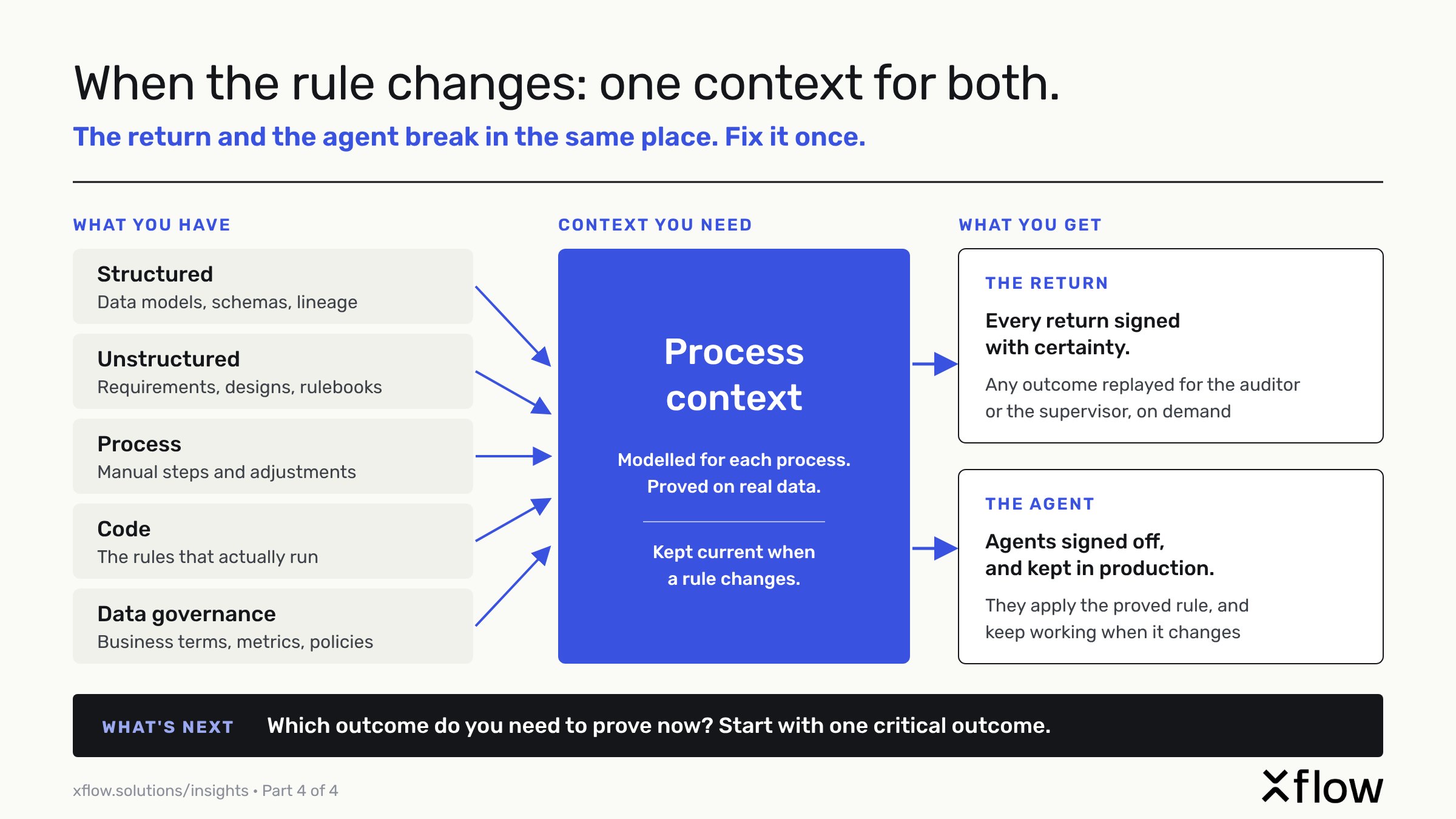
That is the case for building the context once, for one process, and using it twice. xflow takes what the institution already has: data models and lineage, requirements and rulebooks, manual steps, the code that actually runs, business terms and policies. It models them as process context, proves them on real data and keeps them aligned as the business changes.
The people signing the return work from it. The agents running in the process act on it. When a rule changes, both see what it touches before it breaks a report or a decision. Knowing what a change will touch before it is made stops being a project and becomes a property of the process.
The starting point varies. Where there is no context yet, xflow builds it from the documentation and code that already exist. Where there is data governance and context the institution cannot trust, xflow validates every outcome against its objective and closes the gaps it finds. Where there are agents whose outcomes cannot be proved, xflow surfaces and proves the context they use.
Five questions for this quarter
- Which rule changes are coming in the next six months, regulatory or internal?
- For each, can you list every place the rule runs: code, spreadsheet, agent, document?
- Would reporting and the AI team find out about the change at the same time?
- Is anyone accountable for the rule across both, or only within each?
- Which one outcome, if you could prove it end to end, would change the conversation with your supervisor or your risk committee?